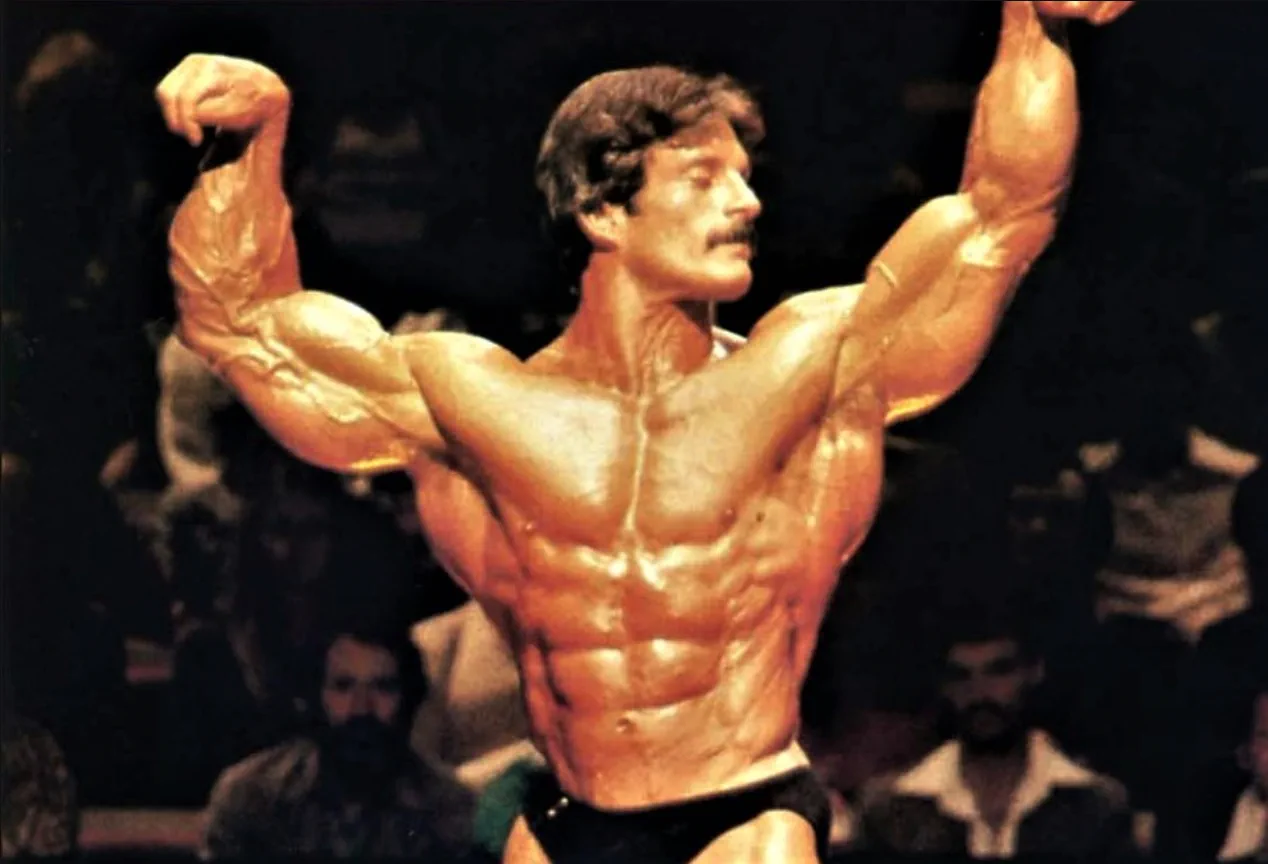
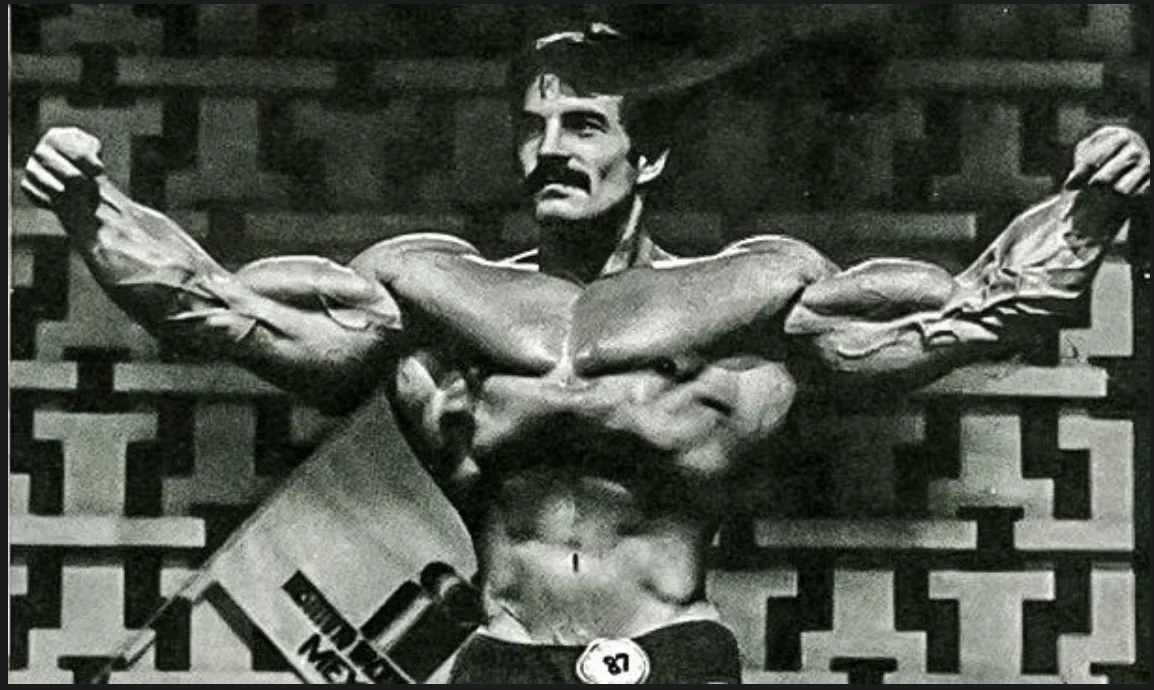
The Awakening
At his first contest he meets Casey Viator — a phenom training under Arthur Jones using High-Intensity principles: brief sessions on Nautilus, heavy weights, sets driven to absolute failure. The encounter rewires Mentzer’s thinking.
DeDe Lifewater
The mind creates the body. The body is the physical manifestation of the mind’s content.
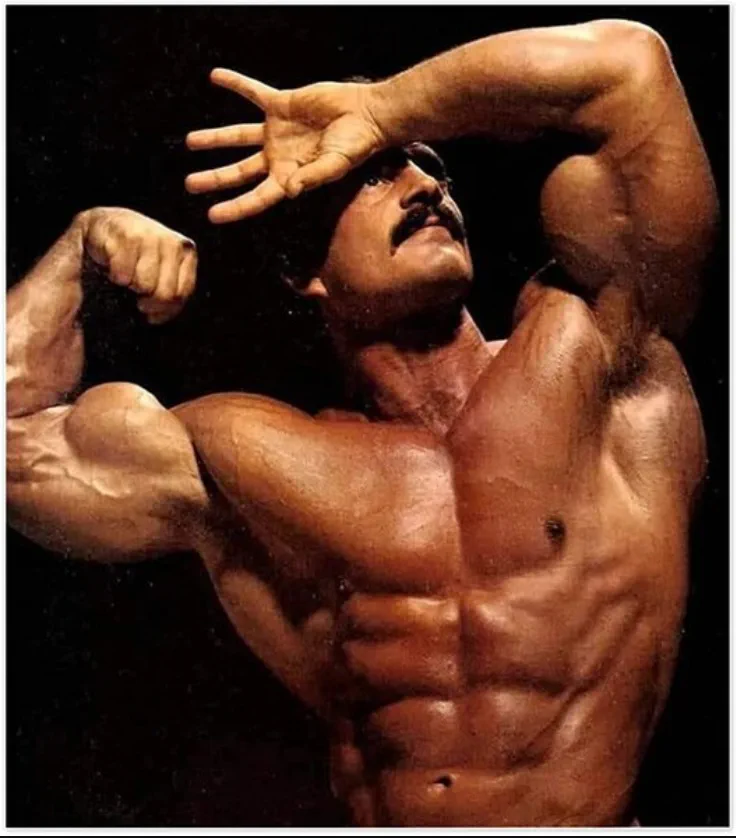
Born in Philadelphia in 1951, Mentzer was a pre-med student before he was a Mr. Universe — a kid who approached the iron with the mind of a scientist and the soul of a philosopher. While his peers chased volume, he chased a single, stubborn question: what actually causes a muscle to grow?
At his first contest he meets Casey Viator — a phenom training under Arthur Jones using High-Intensity principles: brief sessions on Nautilus, heavy weights, sets driven to absolute failure. The encounter rewires Mentzer’s thinking.
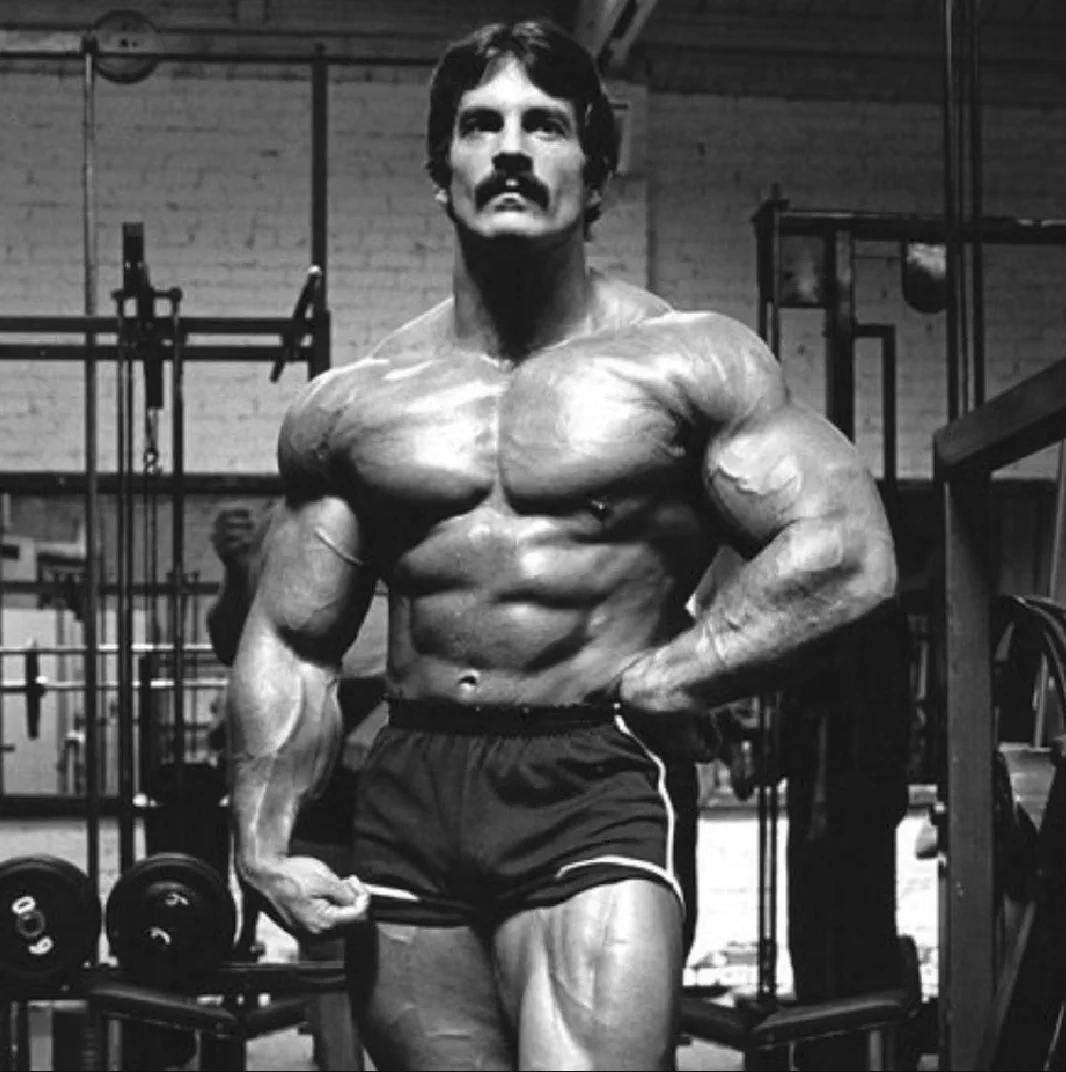
He travels to DeLand, Florida, to meet Jones in person. Strict form. Slow tempo. Train to failure. Avoid overtraining at all costs. Mentzer absorbs the doctrine — and then begins extending it further than its inventor ever did.
He wins the IFBB Mr. America title with a heretical training regimen: 45-minute sessions, three days a week. The establishment is baffled; the results are undeniable.
At the Mr. Universe contest Mentzer earns a perfect 300 — the first in the sport’s history. Proof, he argued, that the mind correctly applied could sculpt flesh into art.
Another perfect score, this time at the Olympia. He takes the heavyweight division but loses the overall to Frank Zane. Heading into 1980 he is the clear favorite. The collision is set.
Mentzer wasn’t merely a bodybuilder — he was a philosopher who used iron as his medium. Rand, Aristotle, Nietzsche: he read them carefully, then dragged their ideas onto the gym floor.
The mind creates the body. The body is the physical manifestation of the mind’s content.
Mike Mentzer · On mind-body integration
“A muscle is what it is. It responds to stress by adapting. The question is not how much can you do — it is how much do you actually need.”
From Rand: the individual must act in accordance with their own best interests. In the gym, that meant rejecting dogma and using reason to find the most efficient path to growth. Most lifters, Mentzer argued, trained not for results but to satisfy an emotional need to "do more."
From Aristotle: a muscle is what it is — tissue that responds to stress by adapting. He rejected the "more is better" fallacy. A is A: a set taken to true failure cannot be improved by performing another.
From Nietzsche: each workout was a confrontation with one’s own potential. Training to failure was not merely physical — it was an act of will, a refusal of mediocrity. The iron was a mirror.
He rejected Cartesian dualism. Bodybuilding required intense concentration, precise calculation, philosophical clarity. The physique was the canvas; the mind, the artist. "Man is an indivisible entity."
Heavy Duty was not a workout program. It was a complete reconceptualization of exercise physiology — refined across decades and thousands of clients, and the most radical departure from conventional training wisdom the sport had ever seen.
Volume is a negative factor. Negative with a capital N. It is not merely inefficient — it is counterproductive.
Mike Mentzer · On training volume
While his peers spent four hours under iron each day, Mentzer finished his workouts before the next man had warmed up. He kept a logbook. He measured. He refused to confuse activity with progress.
You can train hard, or you can train long — but not both. The key is reaching true failure: the point at which 100% of momentary ability is utilized.
If a muscle is getting stronger, it is in the process of positive change. Track every session. Add reps, add weight, cut time. The logbook is sacred.
Muscles don’t grow in the gym — they grow at rest. 4–7 days between sessions for a muscle group; sometimes 14 for advanced trainees. The workout is the stimulus; recovery is the adaptation.
No jerking. No cheating. No momentum. Slow, controlled movement through a full range of motion. Form is non-negotiable.
Forced reps, negatives, rest-pause, static holds. Past positive failure, ensure that no motor unit escapes stimulation.
Isolate the target before the compound. An isolation movement followed immediately by a compound, so the target muscle fails first — not the assisting groups.
In later years, Heavy Duty became radical even by its own standards — as few as one working set per muscle group, performed once every 7–14 days. Critics called it extreme; Mentzer called it logical. He had spent more than a decade refining the system through observation of thousands of clients.
The question, he argued, was not whether it was extreme but whether it was rational. Modern meta-analyses have since validated much of his intuition: single sets to failure can produce equivalent hypertrophy to multiple sets, provided intensity is maximal.
Mentzer left behind hours of unscripted interviews, posing routines, and training breakdowns — most of it now drifting around the corners of the internet. A selection below; press play.
Clicking any tile opens the original clip on YouTube in a new tab. These are public archival uploads — rights stay with their respective owners. We link out instead of embedding so playback always works, even for uploaders who’ve disabled embeds.
October 4, 1980. The Sydney Opera House. What was meant to be the coronation of a new king became the sport’s darkest hour — a collision of ideology, corruption, and the machinery of a sport grappling with its own integrity.
What do I say? Do I say, ‘Nice watch’ or do I say, ‘Why are you wearing a stolen watch?’
Roger Walker · On Arnold’s 1980 victory
By every measure but the scorecard, he was unbeatable that night. The crowd knew it. The press knew it. And then the cards came back.
Schwarzenegger, retired for five years and focused on Hollywood, announced a comeback the day before the contest. He arrived in Sydney officially as a CBS commentator. The field — Zane, Dickerson, Coe, Mentzer, all in peak condition — was blindsided. At the pre-contest meeting, Mentzer nearly came to blows with the Austrian Oak.
Of seven judges, four were Arnold’s close friends or allies. Veteran judge Peter McCarthy was removed hours before the contest, replaced by someone whose judging credentials had been revoked two months prior. Arnold, visibly off his prime with underdeveloped legs, refused certain mandatory poses. He received perfect scores anyway.
When Arnold was named winner over the clearly superior Chris Dickerson, the Sydney Opera House erupted in boos — an unprecedented rebuke in a sport that revered its champions. Mentzer was relegated to fifth. Insiders later confirmed he had been intentionally marked down. CBS, which had paid for broadcast rights, refused to air the contest, declaring it rigged.
Convinced the sport had no room for integrity, Mentzer retired at twenty-nine — in his absolute prime. He boycotted the 1981 Olympia alongside Zane and Coe. He never competed again. The establishment had crushed its most brilliant mind.
Decades later, in the 2023 Netflix documentary Arnold, Schwarzenegger’s 1980 victory is conspicuously absent. While his earlier triumphs are celebrated, his seventh title — his most "impressive" comeback — is erased from the record.
Perhaps because acknowledging it means confronting an uncomfortable truth: that the Sandow trophy that night shone with the luster of corruption, not competition. For Mentzer, the betrayal was absolute. He had offered the sport intellect, integrity, and innovation. The sport offered him politics.
After competition, Mentzer entered his most productive phase — not as a competitor but as a philosopher-trainer. He studied logic and ethics intensively, refined Heavy Duty through thousands of clients, and became the underground guru for those who valued substance over hype.
A young British bodybuilder named Dorian Yates approaches Mentzer. Over five or six sessions at Gold’s Venice, Mentzer transforms his approach. "He challenged me to think about my training more," Yates would later say, "and made me cut back on the volume." Yates goes on to win six consecutive Mr. Olympias — and credits Mentzer at every turn.
Mentzer completes his magnum opus — part training manual, part philosophical inquiry. The Weider magazines respond by attempting to discredit him with anti-HIT articles. He presses on, undeterred.
Old injuries, exacerbated by years of intensity, take their toll. A torn triceps, a clotting disorder, several silent heart attacks. His health deteriorates rapidly. He keeps writing.
June 10. Found at his desk in Venice, California, where he had been working late into the night on a script for a new training video. Forty-nine years old. Cause: a heart attack from severe atherosclerotic disease. Two days later his brother Ray follows him, dying of kidney failure. The dynasty of intensity ends within forty-eight hours.
I’m working on something I’ve never attempted before — a narrative tale about the psychology of a bodybuilder who agonizes about entering his first contest. Talk about challenging. There’s so much I didn’t know but am learning about as I go.
Mike Mentzer · Final email to John Little · May 2001
Mentzer remains one of bodybuilding’s most polarizing figures — not because he was wrong, but because he was right too early. Dismissed as extreme by the volume establishment, his principles have been validated by modern exercise science while his philosophical contributions remain largely unacknowledged.
Modern meta-analyses confirm Mentzer’s central thesis: single sets to failure produce equivalent hypertrophy to multiple sets when intensity is maximal. "One set is enough," once heresy, is now peer-reviewed.
Six-time Mr. Olympia Dorian Yates openly credits Heavy Duty principles as foundational. His "blood & guts" style was Heavy Duty performed with enhanced recovery. Without Mentzer the "mass monster" era may never have arrived.
His insistence on mind-body integration paved the way for modern mind-muscle methodologies. His influence runs through athletes like Kai Greene, who treats visualization as a primary training tool.
Today’s time-efficient protocols — from HIT to minimalist programs — owe their existence to Mentzer’s proof that brief, infrequent, intense training produces superior results to marathon sessions.
No bodybuilder before or since has so rigorously integrated formal philosophy into training methodology. Mentzer introduced thousands of athletes to Objectivism, Aristotelian logic, and existential thought.
In the age of social media, Heavy Duty is experiencing a renaissance. A new generation, disillusioned with volume-based influencer programming, is rediscovering his books, interviews, and principles. The outcast has become the prophet.
The "extremist" label. Critics point to his late one-set-every-two-weeks protocols as proof of irrationality. They ignore that those were advanced applications for elite trainees with maximized recovery demands — not beginner prescriptions. His early Heavy Duty programs were remarkably moderate.
The "drugs" dismissal. Mentzer used performance enhancers, as did all elite competitors of his era. But Heavy Duty was explicitly designed to maximize natural potential — and he trained thousands of drug-free clients with extraordinary success, proving the system’s validity beyond pharmacology.
The "philosopher" caricature. His philosophical bent is often dismissed as pretension by a community that valued brawn over brain. Yet his application of Objectivist epistemology to exercise science was rigorous. He demanded that bodybuilding be treated as an applied science, not a cult of personality. The sport has yet to catch up.
Mike Mentzer was right. One set is enough. The science has caught up to the philosophy.
Modern HIT validation · 2025